

Are We Compatible? The 6 Dimensions That Actually Matter
Compatibility is not about liking the same movies. It is about how you fight, how you spend money, and what you need when you are stressed.
What Compatibility Actually Means
My ex and I liked the same music, the same restaurants, the same TV shows. On paper, we were a perfect match. In practice, we could not get through a single disagreement without one of us shutting down and the other escalating. We were compatible on the surface and fundamentally mismatched underneath. A compatibility test for couples would have caught that within the first ten questions.
Compatibility is not about shared hobbies. It is about shared operating systems. How do you handle stress? What does financial security mean to you? How much closeness is too much closeness? These are the questions that determine whether two people can actually build a life together, and most couples never ask them directly.
Research from the Gottman Institute shows that 69% of relationship conflicts are perpetual. They never get solved. The couples who make it are not the ones who agree on everything. They are the ones who can talk about their differences without contempt. That is what real relationship compatibility looks like. If you want to start with a structured assessment, our free compatibility test for couples breaks this down across six key dimensions.
The 6 Dimensions of Compatibility
Most couples compatibility tests focus on personality traits. But personality is only part of the picture. The couples who last are aligned on six specific dimensions that affect daily life together. You can be wildly different in personality and still be compatible if these six areas line up.
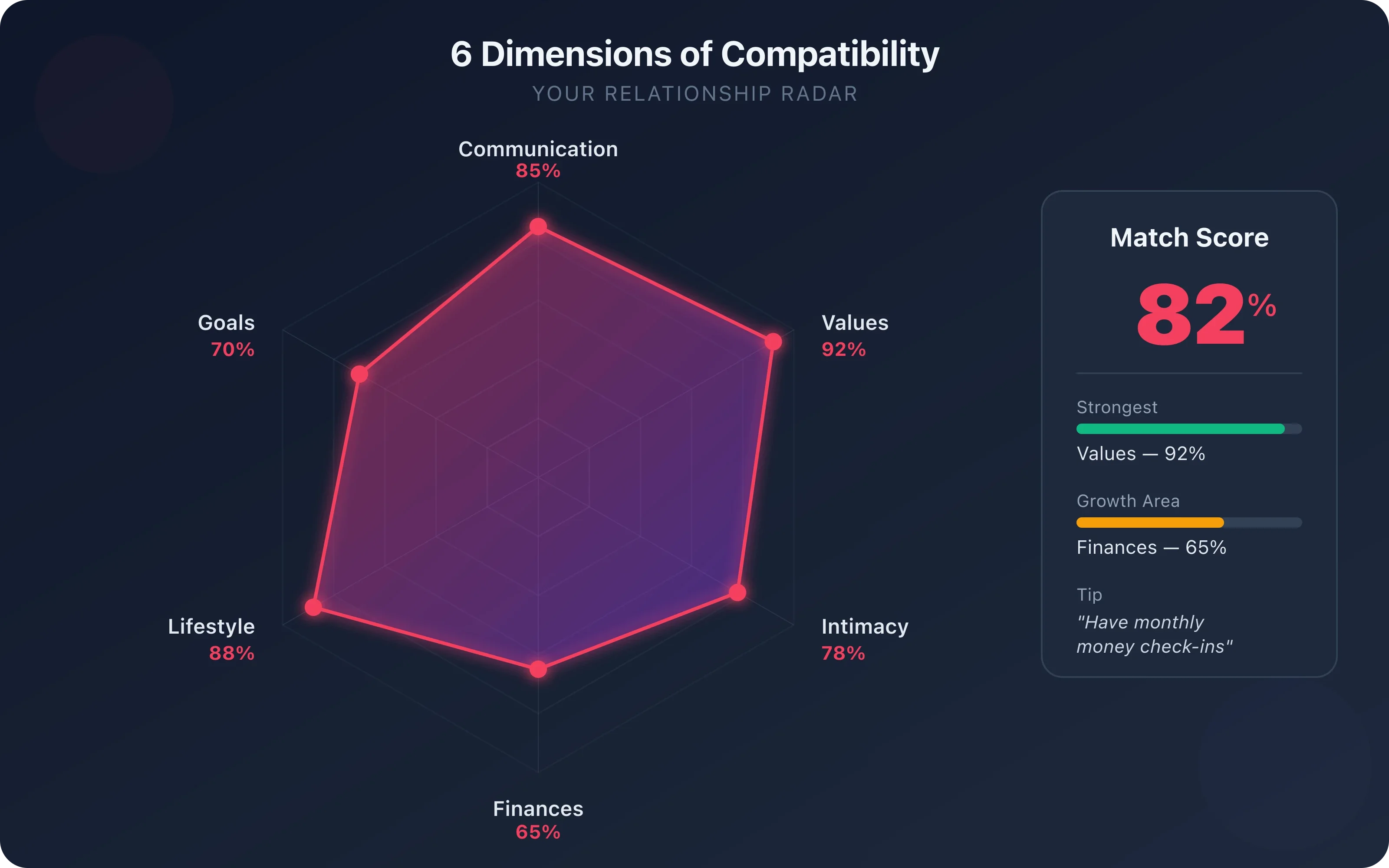
The six dimensions that predict long-term relationship success.
1. Communication Style
This is the single strongest predictor of relationship longevity. It is not about how much you talk. It is about what happens when one of you is upset. Do you move toward each other or away? Do you attack the problem or the person? Couples who score high here can disagree without anyone feeling dismissed or unsafe. Our communication style quiz can help you identify your default pattern.
Signs of Alignment
- Both partners feel heard after a disagreement, even without full agreement
- You can bring up hard topics without fear of punishment or silent treatment
- Repair attempts during fights actually work (humor, touch, de-escalation)
- Neither partner regularly resorts to criticism, contempt, or stonewalling
Signs of Misalignment
- One partner shuts down while the other pursues, creating a chase-retreat loop
- Arguments about small things always spiral into bigger grievances
- One or both partners avoid conflict entirely, letting resentment build
- Conversations feel more like debates where someone has to win
If this dimension feels shaky, start with our communication style quiz to pinpoint where the disconnect lives.
2. Core Values
Values are the non-negotiables. Religion, politics, family involvement, honesty standards, views on monogamy. You do not need identical values, but you need enough overlap that neither person feels they are compromising who they are. Value misalignment is the hardest gap to close because values are tied to identity.
Signs of Alignment
- You agree on the role of family in your lives (holidays, boundaries, priorities)
- Your views on honesty and trust fall in the same range
- You share similar expectations about loyalty, commitment, and fidelity
- Neither person feels they have to hide core beliefs to keep the peace
Signs of Misalignment
- One partner wants a deeply involved extended family, the other wants independence
- Fundamental disagreements on religion or spirituality create ongoing tension
- Different definitions of what counts as honesty or transparency
- One partner feels they are always adapting to the other's value system
3. Intimacy and Affection
Intimacy compatibility goes beyond physical attraction. It includes how you express affection, how often you need physical closeness, and how you respond when your partner reaches for you. Misalignment here creates a slow erosion where one person feels rejected and the other feels pressured. Understanding each other's love language is the first step.
Signs of Alignment
- Both partners feel satisfied with the frequency and quality of physical connection
- You naturally express affection in ways your partner actually receives
- Neither partner feels they have to perform or suppress their natural tendencies
- Physical touch, verbal affirmation, and emotional closeness feel reciprocal
Signs of Misalignment
- One partner consistently wants more closeness while the other pulls back
- Affection feels transactional or like a negotiation
- One partner's love language is invisible to the other
- Physical intimacy becomes a source of conflict rather than connection
Knowing how you give and receive love changes this dynamic. Our love language quiz can show you where the gap is.
4. Financial Compatibility
Money is the number one topic couples fight about, and it is rarely about the amount. It is about what money represents. Security, freedom, status, control. A saver paired with a spender can work beautifully if they understand each other's underlying needs. But if one partner sees saving as safety and the other sees it as deprivation, every purchase becomes a battle.
Signs of Alignment
- You can talk about money without it turning into an argument
- Both partners agree on saving vs. spending priorities
- You share similar views on debt, risk, and financial goals
- Neither partner hides purchases or financial decisions from the other
Signs of Misalignment
- One partner feels anxious about spending while the other feels restricted
- Financial secrets or hidden accounts exist in the relationship
- Different expectations about who earns, who manages, and who decides
- Recurring fights about specific purchases or financial habits
Our financial compatibility quiz helps couples get specific about where their money mindsets align and where they diverge.
5. Lifestyle Preferences
Lifestyle compatibility covers how you spend your time, how social you are, how clean you keep your space, and what your ideal weekend looks like. These are the daily friction points. The introvert who needs quiet evenings paired with the extrovert who fills every weekend with plans. Neither is wrong, but without intentional compromise, both end up resentful.
Signs of Alignment
- Your ideal weekend overlaps enough that planning feels easy
- You agree on the balance between social time and alone time
- Living together feels natural, not like a constant negotiation
- Exercise habits, sleep schedules, and health priorities are compatible
Signs of Misalignment
- One partner feels drained by the other's social calendar
- Housekeeping standards create recurring tension
- Different energy levels mean one partner always feels like they are dragging the other along
- Fundamental disagreements about where to live or how to structure daily life
6. Life Goals and Timeline
This dimension catches couples off guard more than any other. Two people can be perfectly aligned in the present and fundamentally misaligned on the future. Kids or no kids. City or suburbs. Career ambition vs. work-life balance. These are not preferences that change with a good conversation. They are life architecture decisions.
Signs of Alignment
- You share the same timeline for major milestones (marriage, kids, homeownership)
- Career ambitions complement rather than compete with each other
- Both partners feel supported in their individual goals
- You have talked about the future in concrete terms, not just vague ideas
Signs of Misalignment
- One partner wants children and the other does not, and both assume the other will change
- Career priorities pull you toward different cities or lifestyles
- One partner is ready for the next step while the other is not sure about the relationship
- Major life decisions keep getting postponed because you cannot agree on direction

Real compatibility shows up in the small, everyday moments.
How to Assess Your Own Compatibility
An are we compatible quiz is a useful starting point, but real assessment happens in reflection. Before you take any test, sit with these questions on your own. Do not discuss them with your partner first. Your honest, unfiltered answers are what matter.
Self-Reflection Prompts
- When we disagree, do I feel safe saying what I actually think? Or do I filter myself to avoid a reaction?
- Do I feel like I can be fully myself in this relationship, or am I performing a version of myself that keeps things smooth?
- When I imagine our life five years from now, does the picture excite me or make me anxious?
- How do I feel after spending an entire weekend together? Recharged or depleted?
- If money were not a factor, would I still choose to build this life with this person?
- Do I trust my partner with the parts of myself I am most ashamed of?
- When I talk to my friends about my relationship, what do I leave out?
- Am I staying because this is genuinely right, or because leaving feels harder than staying?
The prompts that make you uncomfortable are the ones worth paying attention to. Discomfort is data. It tells you where the relationship needs a conversation, not where it needs to end. Many of our couple questions are designed to open up exactly these kinds of discussions in a way that feels less like an interrogation and more like a real talk.
Compatibility Myths That Need to Die
Myth: Opposites attract (and stay attracted)
Initial attraction often comes from novelty. The quiet person is drawn to the outgoing one. The planner is fascinated by the spontaneous partner. But once the novelty fades, those same differences become daily irritants. Research published in the Journal of Personality and Social Psychology consistently shows that couples with similar values, attitudes, and temperaments report higher long-term satisfaction. Differences in surface traits (introvert vs. extrovert, morning person vs. night owl) are manageable. Differences in core values are not.
Myth: Shared interests mean you are compatible
You can both love hiking, cooking, and indie films and still be a terrible match. Shared interests give you things to do together. They do not tell you how you handle conflict, how you process emotions, or what happens when one of you gets a job offer in another state. Activity partners and life partners are different roles, and confusing them is how people end up with someone who is fun on Saturday but impossible to live with by Wednesday.
Myth: If you are truly compatible, it should not feel like work
Every long-term relationship requires effort. The difference between healthy effort and grinding effort is whether the work feels collaborative or lonely. Compatible couples still argue, still get on each other's nerves, and still go through rough patches. The distinction is that they can repair after conflict without losing respect for each other. If it feels like work in the sense that you are building something together, that is healthy. If it feels like work in the sense that you are constantly trying to change each other, that is a compatibility issue.
Myth: A compatibility test can tell you whether to break up
No quiz, no matter how well designed, can make that decision for you. A couples compatibility test gives you a map of where you are aligned and where you are not. What you do with that information is a human decision, not a data point. Use test results as conversation starters, not verdicts.

The best compatibility assessment happens through honest, ongoing conversation.
What High Compatibility Actually Looks Like
High compatibility is not the absence of conflict. It is not finishing each other's sentences or agreeing on everything. It is more mundane and more powerful than that. Here is what it looks like in practice.
You can be bored together without it feeling wrong. Not every evening needs to be a date night or a deep conversation. Compatible couples can sit in the same room doing their own things and feel completely content. Silence is not uncomfortable. It is just quiet.
Disagreements end with understanding, not winners. You are not trying to prove a point. You are trying to understand why your partner sees it differently. The goal shifts from being right to being connected. That does not mean you agree. It means you stop treating your partner's perspective as a threat.
You root for each other's individual growth. Compatible partners do not feel threatened when the other person changes, gets a promotion, makes new friends, or picks up a new interest. Your partner's growth does not feel like a risk. It feels like good news.
You can predict each other's needs without a script. You know when your partner needs space without them saying it. You know which stressors require comfort and which ones require problem-solving. This is not mind-reading. It is the result of paying attention over time. It is what the Gottman Institute calls a "Love Map," and it is one of the strongest indicators of relationship health.
Date nights feel like something you want, not something you schedule to fix a problem. When compatibility is high, spending quality time together is not a rescue operation. It is just how you like to spend your time. If you need ideas, our romantic date ideas are a good starting point.
Take Our Free Compatibility Test
Get a clear picture of where you and your partner align (and where you do not). Our free compatibility test for couples covers all six dimensions and gives you specific results in under 10 minutes. Want more? Browse all our dating quizzes for couples.
Start the Compatibility CalculatorFree, no account required. Takes about 8 minutes for both partners.
When Incompatibility Is Not a Dealbreaker
Not every area of misalignment means the relationship is doomed. Some gaps are workable. The key is knowing which ones.
Workable misalignments:
- Different social energy levels, as long as both partners respect each other's needs and find a rhythm that works
- Different hobbies and interests. You do not need to do everything together. Having separate passions keeps the relationship interesting.
- Different love languages. These are learnable. Once you know your partner receives love through acts of service rather than words of affirmation, you can adjust.
- Different communication speeds. Some people process emotions in the moment, others need time to think first. This is manageable with awareness.
- Different conflict styles, if both partners are willing to learn a shared approach. Our attachment style quiz helps identify underlying patterns.
Hard-to-bridge gaps:
- Fundamental value differences on children, monogamy, religion, or family involvement. These rarely change through compromise.
- Repeated patterns of contempt, criticism, or stonewalling that neither partner is willing to address
- Wildly different life timelines where one partner is ready for commitment and the other is not sure about the relationship
- Financial philosophies so different that every money conversation becomes a fight
The growth mindset in relationships means accepting that your partner will never be a perfect mirror of yourself, and that is a feature, not a bug. The goal is not perfection. The goal is two people who are willing to keep showing up and doing the work together. Understanding your attachment style can help you understand why certain gaps feel threatening and others feel manageable.
If you want structured conversations to start bridging gaps, our first date questions are not just for first dates. Long-term couples use them to reopen conversations they stopped having years ago.
Frequently Asked Questions
The accuracy depends on the framework behind the test. Quizzes based on validated psychological research (attachment theory, communication patterns, values alignment) tend to provide useful starting points. No quiz replaces honest conversation, but a well-designed compatibility test for couples highlights areas most couples overlook until they become problems. Our compatibility calculator is built around the six dimensions covered in this article.
Yes. Compatibility is not a fixed score. Couples who score lower in certain areas can still build strong relationships if both partners are willing to communicate, compromise, and grow. The areas of misalignment matter more than the overall number. Two people misaligned on core values face harder work than two people misaligned on weekend hobbies.
Communication style consistently ranks as the strongest predictor of long-term relationship success. Partners do not need to agree on everything, but they need to be able to talk about disagreements without shutting down, escalating, or keeping score. How you fight matters more than what you fight about.
A compatibility assessment before marriage can surface blind spots that couples avoid discussing during the engagement phase. Topics like financial habits, family involvement, career priorities, and conflict styles often get overlooked when couples are focused on wedding planning. A structured assessment forces those conversations to happen before they become arguments.
Opposites may create initial attraction, but research consistently shows that similarity in values, communication styles, and life goals predicts long-term satisfaction. Differences in personality traits like introversion vs. extroversion can complement each other, but fundamental misalignment on priorities like finances, family, and lifestyle creates ongoing friction.
About the Author
Rachel MartinezDating & Relationships Writer
Rachel writes about conversation starters, emotional connection, and seasonal date ideas. Her guides give you the actual words to say when you want to get past small talk, and the date ideas to back them up.
Rachel writes the kind of advice she wishes she had when she first started dating. No jargon, no judgment, just honest takes.
View all articles by Rachel →