

Deal Breakers in Relationships
Signs You Should Not Ignore
Why Deal Breakers Matter
Every relationship has friction. Disagreements about where to eat, whose turn it is to do the dishes, or how to load the dishwasher are normal. Those are not deal breakers in a relationship. Real deal breakers are patterns of behavior that make a healthy, respectful partnership impossible, and they are more common than most people think.
According to The Knot's 2024 Relationship and Intimacy Study of over 2,000 respondents, 63% of singles consider dishonesty a top relationship deal breaker, followed by poor communication at 59%. A study analyzed in Psychology Today, published in Personality and Individual Differences, identified six core deal breaker categories and found that apathy and lack of effort were the strongest across genders.
The tricky part is that many relationship deal breakers do not look like deal breakers at first. They show up as small comments, subtle patterns, or things you explain away because everything else feels good. By the time the pattern is obvious, you have already invested months or years.
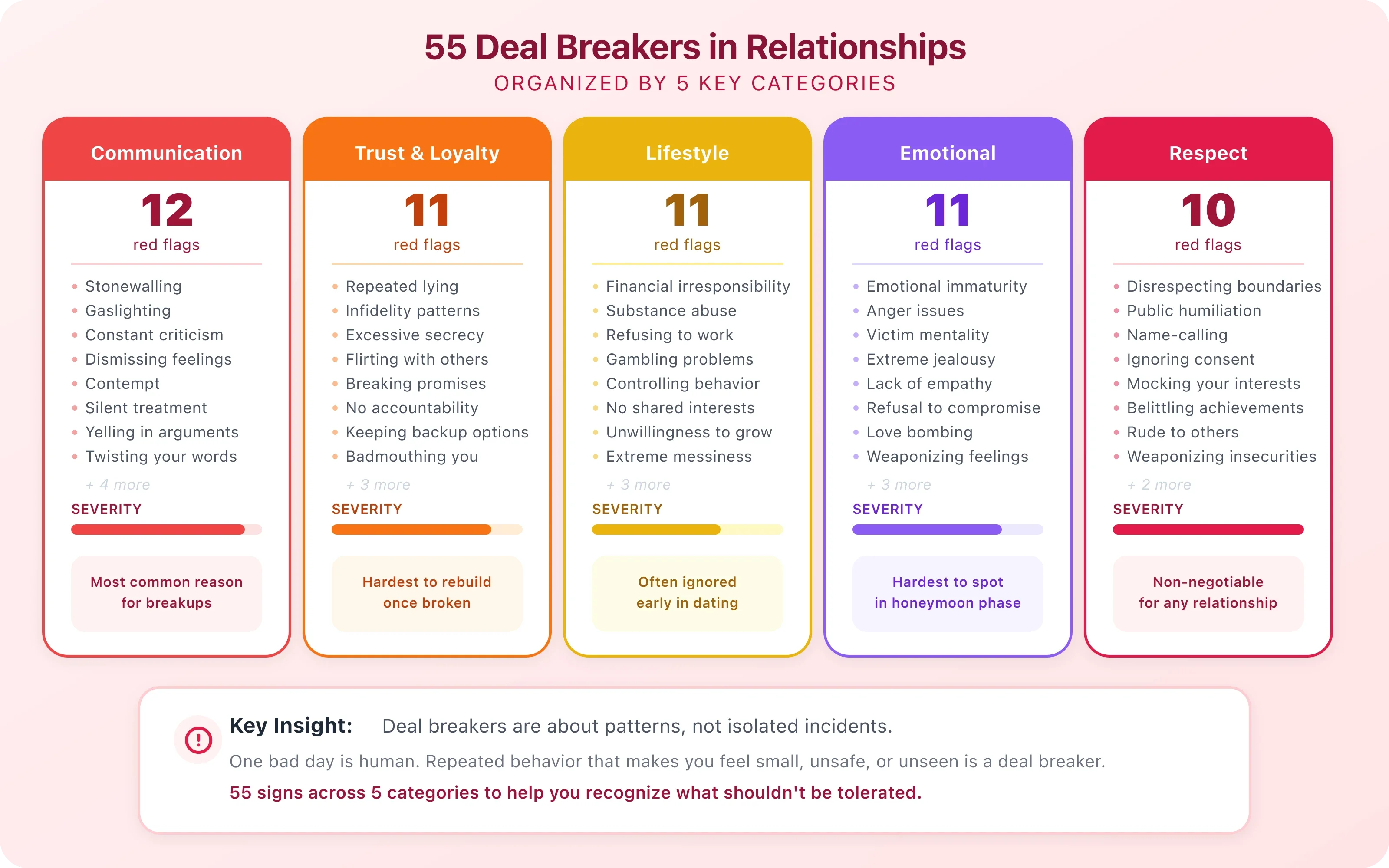
This guide covers 55 of the biggest deal breakers in relationships across five categories: communication, trust, lifestyle, emotional maturity, and values. Some will feel obvious. Others might hit closer to home than you expect. The goal is not to make you paranoid about your partner. It is to help you recognize when something is a genuine problem that will not fix itself. If you want to test your instincts on warning signs, try our Red Flags vs Green Flags tool.

Communication Red Flags
Communication problems are the most common deal breakers in relationships, with 59% of singles in The Knot's study calling poor communication a non-negotiable. These are not about occasional miscommunication or a bad day. These are patterns where one person consistently shuts down, manipulates, or controls conversations to avoid accountability.
Research from the Gottman Institute identifies four communication patterns that predict relationship failure with over 90% accuracy: criticism, contempt, defensiveness, and stonewalling. You will find several of those patterns in this list. If you see them together, it is worth having an honest conversation about where things stand.
Shutting Down Conversation
Stonewalling
They go silent during disagreements, refusing to engage or acknowledge your feelings. This leaves conflicts unresolved and makes you feel invisible.
Gaslighting
They twist reality to make you question your own memory and perception. You start doubting things you know happened because they insist you're wrong.
Constant criticism
Nothing you do is ever good enough. They pick apart your choices, appearance, or personality under the guise of 'helping' you improve.
Dismissing your feelings
When you express hurt or frustration, they tell you you're overreacting or being too sensitive. Your emotions get treated like inconveniences.
Contempt in arguments
They roll their eyes, use sarcasm to belittle you, or speak to you with obvious disgust during disagreements. Contempt is one of the strongest predictors of relationship failure.
Trust & Loyalty Issues
Trust is the foundation of every relationship, and dishonesty is the number one deal breaker in a relationship according to research. Without trust, everything else falls apart. These non-negotiables center on honesty, loyalty, and whether your partner treats the relationship as something worth protecting.
Rebuilding trust after a single incident is possible with effort from both sides. But when dishonesty or disloyalty becomes a pattern, it signals a deeper issue with how your partner values the relationship and you as a person.
Broken Trust Patterns
Repeated lying
Small lies add up. If they lie about minor things, you will never be sure what else they are not telling you. Trust requires consistency, not just promises.
Infidelity patterns
One mistake is complicated. A pattern of cheating shows a fundamental disregard for the relationship and for you as a person.
Excessive secrecy
They guard their phone, have passwords on everything, and get defensive when you ask simple questions. Healthy privacy is different from deliberate concealment.
Flirting with others in front of you
They openly flirt with other people while you are standing right there. When you bring it up, they say you are being jealous or insecure.
Breaking promises consistently
They say one thing and do another. Plans get canceled, commitments get forgotten, and you learn that their word means very little.
Deal Breaker vs. Dealmaker
Knowing what you will not accept is just as important as knowing what you need. A deal breaker is not the opposite of a preference. It is a hard line that protects your wellbeing. Here is how to tell the difference:
Deal Breakers:
- ✗Patterns that repeat after direct conversation
- ✗Behaviors that violate your core values
- ✗Actions that make you feel unsafe or disrespected
- ✗Issues your partner refuses to acknowledge
Just Preferences:
- ✓Minor habits that mildly annoy you
- ✓Different tastes in food, music, or hobbies
- ✓Things that can be resolved with a conversation
- ✓Differences that do not affect respect or safety
Want to have a real conversation about what matters most to both of you? Our couple questions guide has prompts that help couples talk about the hard stuff without it turning into a fight.
Lifestyle Compatibility
Love is not enough to sustain a relationship. You also need to be able to build a life together. These dating deal breakers focus on the practical side of partnership: money, habits, health, and how you spend your time. Financial incompatibility alone is a top deal breaker, with a TD Bank survey finding that 71% of people would consider ending a relationship over financial dishonesty.
Lifestyle clashes are easy to overlook when feelings are strong. But they become impossible to ignore once the honeymoon phase ends and daily life takes over. Pay attention to how your partner handles responsibilities and whether they are willing to meet you halfway.
Money & Habits
Financial irresponsibility
They rack up debt without a plan, hide purchases, or expect you to fund their lifestyle. Money problems cause more breakups than almost anything else.
Substance abuse
Drinking or drug use that affects their behavior, reliability, or health. If they refuse to acknowledge or address the problem, it will only get worse.
Refusing to work or contribute
They have no ambition, no job prospects, and no interest in pulling their weight. A partnership requires two people building something together.
Extreme messiness or hygiene issues
Basic cleanliness and organization matter for shared living. If they refuse to maintain their space or themselves, daily life together becomes a constant source of friction.
Gambling problems
They take reckless financial risks and hide the losses. Gambling addiction can drain savings, create debt, and destroy the financial stability you are building together.

Emotional Maturity Red Flags
Emotional maturity is the ability to handle conflict, take responsibility, and support your partner through hard times. Without it, even small disagreements spiral into major issues.
These deal breakers are about how your partner handles emotions, both theirs and yours. An emotionally immature partner will make you feel like you are always walking on eggshells, constantly managing their feelings instead of living your life.
Avoiding Responsibility
Blame-shifting
Every problem is someone else's fault. If they cannot take responsibility for their own actions, conflict resolution is impossible.
Inability to apologize
They would rather argue for hours than say 'I was wrong.' A genuine apology is one of the most basic relationship skills, and refusing to do it is a serious red flag.
Emotional outbursts over small things
Minor inconveniences trigger disproportionate rage or tears. If they cannot regulate their emotions over small stuff, bigger challenges will be much harder.
Playing the victim constantly
They frame every situation so they are the one being wronged. This makes it impossible to address real problems because the conversation always circles back to their suffering.
Punishing you for setting boundaries
When you say no or establish a limit, they guilt-trip you, give you the silent treatment, or act like you are being unreasonable. Healthy people respect boundaries.
Check In With Yourself
As you read through these deal breakers in relationships, pay attention to what you feel, not just what you think. If something on this list made your stomach drop or triggered a specific memory, that reaction matters. Ask yourself:
- 1How many of these patterns do I recognize in my current relationship?
- 2Have I brought these up with my partner? What happened when I did?
- 3Am I making excuses for behavior that I would tell a friend to leave?
Being honest with yourself is the hardest part. If you want a structured way to reflect on your relationship, our relationship quizzes can help you think through what you need.
Values & Goals Misalignment
You can love someone deeply and still be fundamentally incompatible. Values and life goals are the long-term framework of a relationship. When they do not align, one or both of you will eventually feel like you are sacrificing who you are.
These deal breakers are not about right or wrong. They are about compatibility. Two good people can have values that simply do not work together, and staying in that situation does not serve either of you.
Core Value Clashes
Different views on having children
One of you wants kids and the other does not. This is not something you can compromise on, and hoping the other person will change their mind leads to resentment.
Incompatible religious or spiritual beliefs
If faith plays a major role in one person's life and the other is opposed to it, daily decisions, holidays, and raising a family become constant points of conflict.
Fundamentally different political values
Surface-level political differences are manageable. But when your core values about human rights, equality, or governance clash, it affects how you see the world together.
Different views on monogamy
If one person wants an open relationship and the other wants exclusivity, forcing either to change creates pain. This needs to be aligned, not negotiated under pressure.
Disrespecting your family or culture
They mock your traditions, dismiss your family, or refuse to engage with your cultural background. A partner should respect where you come from, even if they come from somewhere different.
What To Do When You Spot a Deal Breaker
Recognizing a deal breaker is only the first step. What matters next is what you do with that information. Here is a practical framework:
- Name it clearly. Identify the specific behavior or pattern. Vague feelings of unhappiness are harder to address than concrete examples.
- Have a direct conversation. Tell your partner what you have observed and how it affects you. Use specific examples rather than generalizations.
- Give it a timeline. Real change takes effort, but it also requires accountability. If nothing shifts after a reasonable period, the pattern is the answer.
- Trust your decision. Leaving a relationship over a deal breaker is not failure. It is self-respect. Staying in a situation that violates your core needs will cost more in the long run.
If you are unsure about where you stand, taking a relationship quiz can help you reflect on what you really need from a partner. And if the behavior feels more like manipulation disguised as affection, read our guide on love bombing signs to understand the difference.
Key Takeaways: Deal Breakers in Relationships
- Trust and communication are the two most common relationship deal breakers, flagged by over 60% of people in surveys.
- Patterns matter more than incidents. A single mistake is forgivable. A repeated pattern despite direct conversation is a deal breaker.
- Emotional maturity affects everything. A partner who cannot apologize, regulate emotions, or respect boundaries will make every other problem worse.
- Values alignment is non-negotiable long-term. Love is not enough if you disagree on children, finances, or how to build a life together.
- Knowing your deal breakers is self-respect. Leaving a relationship that violates your core needs is not failure. It is the foundation of finding something better.
Related Guides
Love Bombing Signs
35 red flags disguised as romance that you need to recognize early.
Couple Questions
Deep conversation starters that help couples talk about what really matters.
First Date Questions
100+ questions to spot compatibility early and make a great first impression.
Frequently Asked Questions
Common questions about relationship deal breakers
A deal breaker is a behavior, value, or pattern that makes a healthy relationship impossible for you. It is not about minor annoyances or preferences. Deal breakers are non-negotiable issues like dishonesty, abuse, or fundamental value clashes that undermine the foundation of a partnership.
Everyone's deal breakers are slightly different, but the common thread is that they involve respect, safety, and core values. Knowing yours ahead of time saves you from rationalizing behavior that will not change.
A rough patch is temporary and both people are willing to work through it. A deal breaker is a pattern that repeats despite conversations about it. If you have clearly communicated your needs and nothing changes, or if the behavior violates your core values, it is likely a deal breaker rather than a phase.
Ask yourself: has this happened before? Did they acknowledge it? Did anything actually change? If the answers are yes, no, and no, you have your answer.
Your deal breakers can shift as you grow and gain experience. Something that seemed tolerable in your twenties might be unacceptable in your thirties. The important thing is to regularly check in with yourself about what you need and be honest with your partner about those needs.
Yes. Sharing your non-negotiables early prevents wasted time and heartache for both people. You do not need to present a list on the first date, but by the time you are getting serious, your partner should know where your hard lines are.
Bringing these up does not have to be heavy. Our couple questions guide has prompts that make it easier to talk about the things that matter most.
Having standards is healthy. Having a rigid checklist that no real human could meet is not. Focus on the things that truly matter for your wellbeing and the health of the relationship. Core deal breakers around respect, honesty, and shared values make sense. Rejecting people over minor preferences limits your chances of finding a good match.
A red flag is an early warning sign that something could become a problem. A deal breaker is a confirmed pattern that already is a problem. Red flags are worth watching. Deal breakers are worth acting on. For example, your partner canceling plans once is a red flag. Canceling plans consistently and refusing to acknowledge it is a deal breaker.
Test your ability to tell the difference with our Red Flags vs Green Flags game.
The core deal breakers in marriage and dating are the same: dishonesty, disrespect, abuse, and incompatible values. The difference is what is at stake. In dating, walking away is simpler. In marriage, there are shared finances, possibly children, and legal ties that make the decision harder. That does not mean you should tolerate deal breakers in a marriage. It means identifying them early, before commitment deepens, saves both people significant pain.
Research in Personality and Individual Differences found that women tend to have stronger deal breaker ratings overall than men, particularly around apathy, lack of ambition, and poor hygiene. Men were more likely to cite clinginess and lack of physical attraction. Both genders rated dishonesty, substance abuse, and abusive behavior as top relationship deal breakers. The common thread is that respect and effort matter to everyone.
The biggest dealbreakers consistently cited in research are dishonesty, lack of respect, infidelity, and any form of abuse. Beyond those, common deal breaker examples include refusing to communicate during conflict, substance abuse problems, financial irresponsibility, and a complete lack of ambition or effort. What makes something a dealbreaker versus an annoyance is whether it violates your core values and whether the person is willing to change.
Knowing your dealbreakers early helps you ask better questions from the start. Our first date questions guide has conversation starters that reveal compatibility early.
About the Author
Jesse JohnsonFounder & Editor-in-Chief
Jesse built DateIdeas.com from scratch after years of learning what actually works in dating, mostly by getting it wrong first. He learned that real connection comes from genuine curiosity and good timing, not memorized lines or playing games. That perspective drives every piece of content on the site.
He writes about dating, relationships, and communication for people who want practical advice without the pickup artist nonsense. His approach is simple: be interesting, be interested, and don't overthink it.
View all articles by Jesse →