
Dating Red Flags: Warning Signs Ranked by the Community
Over 500 dating scenarios voted on by thousands of real people. These are the behaviors they flagged as the biggest warning signs in dating.
Play the Game and Add Your VoteThe 10 Biggest Dating Red Flags
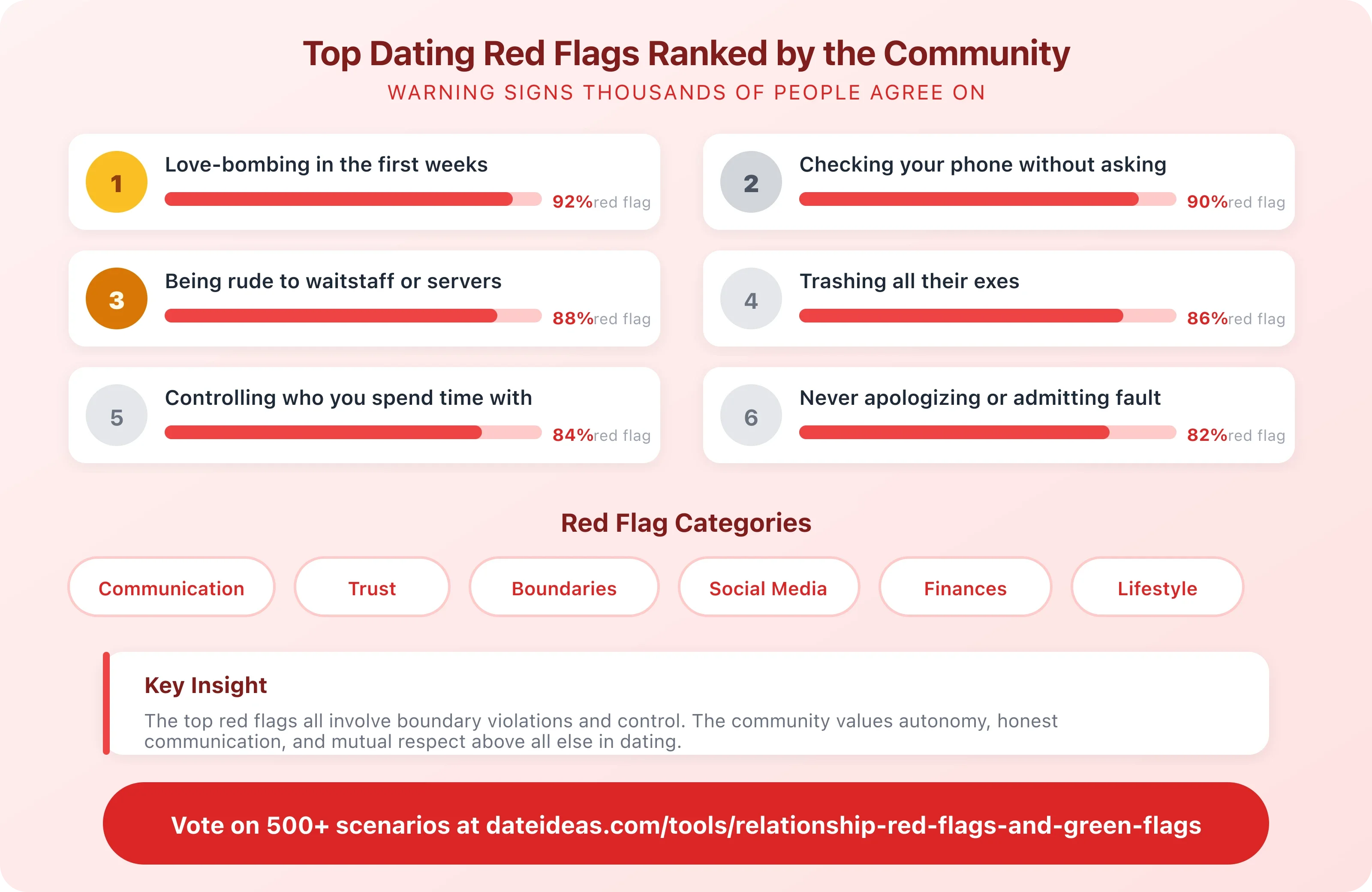
These are the scenarios the community rated most consistently as red flags, with near-unanimous agreement across thousands of votes.
Rude or dismissive to waitstaff, delivery drivers, or service workers
How someone treats people they perceive as 'below' them tells you everything about their character. It's a reliable preview of how they'll eventually treat you.
Talks extensively about an ex on the first few dates
Whether it's hate or nostalgia, it signals they haven't moved on. Your job on a date isn't therapist — it's potential partner.
Checks their phone constantly during dinner without explanation
Consistent phone use signals you're not the priority. Once is fine. Every five minutes is a pattern.
Gets angry or sulky when you set a boundary
Healthy partners respect limits even when they don't love them. Pushback against a reasonable no is one of the clearest early warnings.
Pressures you to drink when you've declined
Respecting a simple 'no thanks' costs nothing. Ignoring it reveals a disregard for your choices that tends to show up elsewhere too.
Doesn't want you to have friends outside the relationship
Isolation is a classic control tactic. A secure partner encourages your independence rather than threatening it.
Makes negative comments about all their exes
Everyone has one difficult ex. When every ex is a villain, the common denominator becomes clear.
Talks only about themselves without asking about you
Curiosity about a partner is fundamental. A first date that's a monologue tells you how future conversations will go.
Love-bombs heavily in the first few weeks
Intensity that moves much faster than the relationship has earned often flips to withdrawal, guilt, or control once you're invested.
Shows up significantly late without communicating
Chronic lateness without a message signals your time isn't valued. It's not about the minutes — it's about the consideration.
Want to weigh in? Play the Red Flag Green Flag game to vote on 500+ scenarios and see how your instincts compare to the community.
Full Community Rankings
All scenarios ranked by red flag percentage, updated in real time as new votes come in.
Top Community Red Flags
Showing 1-18 of 100 resultsThreatens to leave during every argument
Is rude to service workers and staff
Refuses to ever apologize.
Blames everyone else for problems
Expects you to give up your dreams
Keeps in touch with exes for "backup."
Never admits when they're wrong
Gaslights you and questions your memory
They bring up your past mistakes during unrelated arguments
Tries to turn you against your friends
Never apologizes or changes behavior
Makes you feel guilty for having personal time
Dismisses your feelings as overreactions
Flirts with strangers in front of you.
Uses personal insults during arguments
Ghosts for a week then comes back casually.
Pressures you to drink alcohol when you decline
Constantly criticizes your appearance
What Are Dating Red Flags?
Dating red flags are behaviors, patterns, or attitudes that signal potential problems in a relationship. Some are obvious — aggression, dishonesty, controlling behavior. Others are subtler, like someone who only texts you late at night, never makes future plans, or consistently centers every conversation on themselves.
The tricky part is that red flags rarely come labeled. They tend to show up as small moments that feel slightly off — a comment that lands wrong, a reaction that seems disproportionate, a pattern that builds slowly until it's hard to ignore. That's why talking through scenarios with other people, or seeing how thousands of others react to the same situations, can help sharpen your instincts.
The rankings on this page reflect community votes across 500+ real dating scenarios. Near-unanimous red flags (95%+) represent behaviors that most people consider serious warning signs regardless of context. Scenarios in the 60-80% range tend to be more nuanced — they might be red flags for some people and not others depending on values, communication style, and relationship expectations.
It's also worth remembering that a single red flag isn't a verdict. Context matters. One late arrival is different from a pattern of it. The question is whether behaviors are consistent and whether they improve or worsen when addressed directly.
Compare these rankings with the top green flags to see what positive behaviors the community values most, try the Red or Green Flag questions list for a conversation-starter with your partner, or check out the Red Flag Green Flag game to play through scenarios yourself.
Red Flags vs. Dealbreakers: What's the Difference?
A red flag is a warning sign that warrants attention. A dealbreaker is a behavior or value mismatch that ends a relationship. Not every red flag is a dealbreaker, but every dealbreaker usually started as a red flag that was either missed or dismissed.
For example, someone who checks their phone constantly on a first date might just be nervous or dealing with something urgent. Worth noting, not necessarily worth walking out over. But if it continues every time, combined with other signs of disengagement, the pattern becomes meaningful.
The most reliable approach is to pay attention early, name what you notice rather than explaining it away, and see how the other person responds when you bring it up. Someone who gets defensive about a concern tends to validate it. Someone who listens and adjusts is showing you a green flag in how they handle friction.