
Spotting Relationship Red Flags
and Green Flags
Why Relationship Awareness Matters
The early stages of a relationship can be tricky. Emotions run high, but so do blind spots. When you're caught up in the excitement of new love, it's easy to overlook warning signs or dismiss concerns that might otherwise seem obvious. Your heart races, you feel an intense connection, and suddenly red flags can look like quirks or signs of passion.1
Understanding relationship red flags and green flags helps you make better choices about who you invest your time and heart in. Sometimes what feels like intense chemistry is actually codependency, love bombing, or emotional manipulation in disguise. Learning to spot these patterns early can save you from months or years of emotional turmoil.

You'll learn to identify common red flags that signal potential problems, celebrate green flags that indicate healthy relationship patterns, and recognize the critical difference between warning signs and opportunities for growth. We'll look at the psychology behind why we ignore deal breakers, what healthy relationships actually look like, and when to work through issues versus when to walk away.
Ready to test your instincts? The Red & Green Flag Game on DateIdeas.com offers a fun, interactive way to sharpen your relationship awareness. No matter where you are in your relationship, you'll pick up practical skills for making smarter choices about your love life.
Common Relationship Red Flags
Red flags are warning signs that something might be unhealthy or harmful in a relationship. They're behaviors, patterns, or situations that indicate potential problems ahead. Spotting a single red flag doesn't automatically mean ending things, but multiple red flags or patterns of concerning behavior demand serious attention and reflection.
The key to recognizing relationship red flags is understanding that they often appear gradually and can be disguised as love, passion, or care. What starts as "they just really care about me" can evolve into controlling behavior. What seems like "they're so into me" might actually be love bombing. Learning to identify these warning signs early (and trusting your gut when something feels off) is one of the most important relationship skills you can develop. Try the interactive flag game to test your instincts.
Love bombing is when someone showers you with excessive affection, attention, and grand gestures early in the relationship to create intense emotional dependence.
Warning Signs:
- Over-the-top affection within days of meeting
- Constant texting and demands for your attention
- Saying "I love you" extremely early
- Extravagant gifts or grand romantic gestures right away
- Talking about the future (marriage, kids) after just a few dates
- Making you feel like you're in a fairytale relationship
Love bombing signs often precede controlling or manipulative behavior once the person feels you're emotionally attached.
Passive-aggressive behavior is indirect expression of hostility through actions like sulking, silent treatment, or backhanded compliments instead of honest communication.
Warning Signs:
- Giving you the silent treatment instead of talking about issues
- Making sarcastic or cutting remarks disguised as jokes
- Agreeing to do something but "forgetting" or doing it poorly
- Saying "I'm fine" when clearly upset, then acting cold
- Refusing to discuss what's bothering them
- Making you feel guilty without explaining why
Healthy relationships require direct, honest communication about feelings and needs.
Gaslighting is a form of psychological manipulation where someone makes you question your own memory, perception, or sanity.
Warning Signs:
- "That never happened" (denying events you clearly remember)
- "You're too sensitive" (dismissing your valid feelings)
- "You're crazy" or "You're imagining things"
- Twisting facts to make you doubt yourself
- Accusing you of being the problem when you bring up their behavior
- Making you feel like you can't trust your own judgment
Gaslighting signs are a serious form of emotional abuse that erodes self-confidence and mental health.
Stonewalling occurs when one partner shuts down emotionally, refuses to engage in conflict resolution, or completely withdraws from difficult conversations.
Warning Signs:
- Walking away mid-conversation without explanation
- Refusing to discuss relationship problems
- Ignoring your attempts to talk about issues
- Acting like problems don't exist by avoiding them
- Changing the subject whenever conflict arises
- Emotional shutdown that lasts for days
While taking a brief break during heated arguments can be healthy, chronic stonewalling in relationships prevents resolution and real closeness.
Codependency is when one or both partners have an unhealthy emotional reliance on the other, often sacrificing their own needs, boundaries, and identity.
Warning Signs:
- Constantly putting their needs before your own to your detriment
- Feeling responsible for their emotions and happiness
- Difficulty making decisions without their input
- Fear of being alone or abandoned
- Losing your sense of self or personal interests
- Making excuses for their harmful behavior
Healthy relationships involve interdependence, where partners support each other while maintaining their own identities. Codependency signs indicate an imbalance that requires attention.
Quick Reference List:
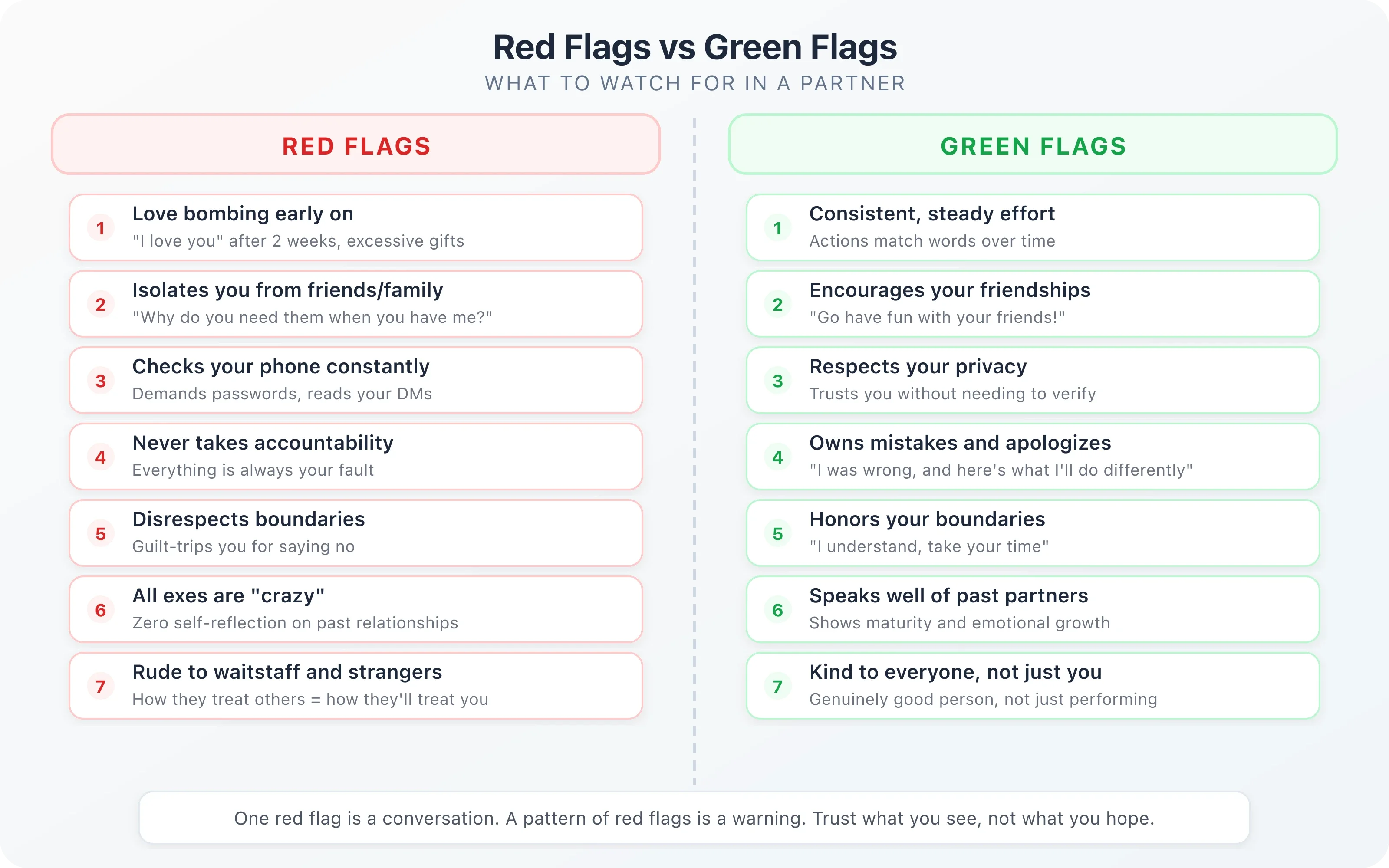
- They only apologize when caught, not because they understand the harm
- They isolate you from friends and family
- They constantly criticize or belittle you
- They have double standards (rules for you but not for them)
- They blame others for all their problems
- They refuse to take accountability for their actions
- They're jealous or possessive in unhealthy ways
- They pressure you sexually or dismiss your boundaries
- They track your location or monitor your communications
- They threaten to harm themselves if you leave
Trust Your Instincts
If something feels off, it probably is
The Psychology Behind Red Flags
Understanding why we sometimes ignore deal breakers in relationships can help us make better choices moving forward. According to research2, there are several psychological factors at play:
Attraction Bias
When we're physically or emotionally attracted to someone, our brain releases dopamine and oxytocin (the same chemicals associated with addiction). This can cloud our judgment and make us overlook warning signs we'd normally catch.
Fear of Being Alone
Many people stay in unhealthy relationships because the fear of being single feels worse than dealing with red flags. This fear can lead to rationalizing bad behavior or lowering standards.
The "Fixer" Mentality
Some people are drawn to partners who need "saving" or "fixing." They believe their love can change someone, even when patterns of behavior suggest otherwise. This often leads to emotional exhaustion and disappointment.
Emotional Conditioning
Love bombing and other manipulative tactics create powerful emotional bonds quickly. The intensity feels exciting and validating, making it harder to recognize that it's not sustainable or healthy.
Important Note:
Spotting red flags early doesn't mean you have to end things immediately. It means paying attention before patterns form and having honest conversations about concerns. Some issues can be worked through with communication and mutual effort, but only if both people are willing to grow.
For more information on identifying manipulative behaviors, visit the National Domestic Violence Hotline.
Test Your Relationship Instincts
Think you can spot warning signs? Try the Red & Green Flag Game, an interactive way to sharpen your relationship awareness through real-world scenarios.
"They check your phone constantly and get upset if you don't respond within minutes."
"They rarely ask about your day or interests, mostly talking about themselves."
"They respect your boundaries and apologize sincerely when they make mistakes."
What You'll Get:
Green Flags: Signs of a Healthy Relationship
Red flags warn us of potential problems, but green flags reveal what healthy relationships actually look like3. These positive signs indicate emotional safety, mutual respect, and long-term compatibility. Green flags aren't about perfection. They're about consistent patterns of behavior that demonstrate real care, respect, and emotional maturity.
In contrast to red flags that make you feel anxious, confused, or walking on eggshells, green flags make you feel secure, valued, and free to be yourself. They're the behaviors that show someone is emotionally available, trustworthy, and invested in building something real with you. Practice recognizing these with the relationship assessment tool.
Healthy couples actively invest in their relationship by planning quality time together. Partners who regularly look up date ideas near them and make an effort to plan things together show commitment and follow-through. Both are strong green flags that point to a thriving relationship.

Healthy boundaries in relationships mean both people can express their needs, limits, and personal space without fear of punishment or guilt.
Green Flag Signs:
- You can say "no" without feeling guilty or facing consequences
- They respect your need for alone time or space
- Both partners can maintain separate friendships and interests
- Physical boundaries are always respected without pressure
- You feel comfortable expressing when something bothers you
- Boundaries are discussed openly and adjusted as needed
Healthy couples don't avoid conflict. They handle it constructively with conflict resolution skills, with the goal of understanding rather than winning.
Green Flag Signs:
- Arguments end with understanding, not punishment or silent treatment
- Both people listen to each other's perspectives
- Disagreements focus on the issue, not attacking character
- Apologies are sincere and followed by changed behavior
- You can disagree without fear of the relationship ending
- Conflicts lead to growth and deeper understanding
Both partners take responsibility for their actions, admit mistakes, and actively work to improve.
Green Flag Signs:
- They admit when they're wrong without making excuses
- Both people take ownership of their part in conflicts
- They follow through on commitments and promises
- Feedback is received with openness, not defensiveness
- Growth and self-improvement are ongoing priorities
- They hold themselves to the same standards they expect from you
Healthy communication involves active listening, emotional validation, and encouragement rather than criticism.
Green Flag Signs:
- They listen without interrupting or dismissing your feelings
- Your accomplishments are celebrated, not minimized
- They ask about your day and genuinely care about the answer
- Difficult conversations happen with kindness and respect
- They validate your emotions even when they don't fully understand
- Encouragement and positive reinforcement are common
Secure relationships allow both people to maintain their individuality, friendships, and interests without jealousy or control.
Green Flag Signs:
- You can have friends and hobbies outside the relationship
- Trust is the default, not something that needs to be earned daily
- They don't monitor your phone, location, or social media
- Spending time apart is healthy, not threatening
- Personal growth is encouraged, not seen as growing apart
- You feel secure even when you're not together
Quick Reference List:
- They celebrate your wins genuinely
- They keep promises and follow through
- Apologies are sincere and include changed behavior
- Your family and friends like and trust them
- They introduce you to their important people
- Consistency in words and actions
- They respect your career and ambitions
- Vulnerability is met with care, not judgment
- They make you feel emotionally safe
- Life feels better with them in it